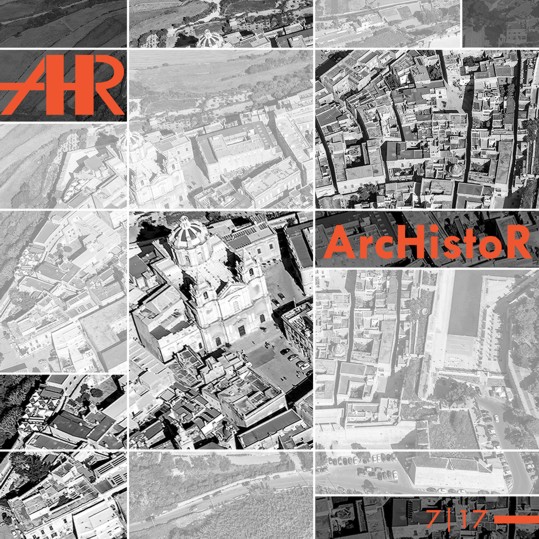
Architecture and urban transformations of Mdina during the reign of Grand Master Anton Manoel de Vilhena (1722-1736)
DOI:
https://doi.org/10.14633/AHR054Parole chiave:
Mdina, Malta, Order of St John, Cathedral Chapter, urban spaceAbstract
The origins of the walled town of Mdina date back to the Roman period although its present-day physical boundaries were defined during the Arab occupation of Malta (870-c.1090). In medieval times, during the Aragonese rule (1283-1530), Mdina or the Città Notabile as it was then known, thrived and prospered as it was the main urban settlement on the island. However, during the 16th and 17th centuries when Malta was under the rule of the Order of St John, Mdina was in decline and lost its political and economic preeminence to the new ‘city of the Order’, Valletta.
This paper will consider the impact of the 1693 earthquake and the various post-earthquake reconstruction efforts of the local church which sought to consolidate its presence as the traditional Episcopal see. The reconstruction of the old medieval cathedral, a new bishop’s palace and later a Seminary building were an integral part of an architectural enterprise, which the Cathedral Chapter spearheaded with a view to enhancing its presence within the city. However in 1722, with the election of the Portuguese grandmaster António Manoel de Vilhena (r. 1722-1736), the Order of St John for the first time demonstrated a real interest in intervening within the walled town. Vilhena embarked upon an extensive urban renewal programme by re-planning the entire approach and entrance area of Mdina, building an imposing Baroque-style Magisterial palace and Corte Capitanale, together with an ornate Banca Giuratale building. Vilhena’s urban renewal of the Mdina had the political objective of appropriating the representation of the walled town from the traditional seat of the bishop and local Università, and of transforming it into another miniature ‘city of the Order’.
##submission.downloads##
##submission.additionalFiles##
- list of figures (English)
- figure 1 (English)
- Figure 2 (English)
- Figure 3 (English)
- Senza titolo (English)
- Senza titolo (English)
- Senza titolo (English)
- Senza titolo (English)
- Senza titolo (English)
- Senza titolo (English)
- Senza titolo (English)
- Senza titolo (English)
- Senza titolo (English)
- Senza titolo (English)
- Senza titolo (English)
- Senza titolo (English)
- Senza titolo (English)
- Senza titolo (English)
- Senza titolo (English)
- Senza titolo (English)
- Senza titolo (English)
- Senza titolo (English)
- Senza titolo (English)
- Senza titolo (English)
- Senza titolo (English)
- Senza titolo (English)
- Senza titolo (English)
- Senza titolo (English)
Pubblicato
Come citare
Fascicolo
Sezione
Licenza
Copyright (c) 2017 Conrad Thake

Questo lavoro è fornito con la licenza Creative Commons Attribuzione - Non commerciale 4.0 Internazionale.
ArcHistoR pubblica sul web, in open access
Gli autori che pubblicano su questa rivista accettano le seguenti condizioni:
- Gli autori mantengono i diritti sulla loro opera e cedono alla rivista il diritto di prima pubblicazione dell'opera, contemporaneamente licenziata sotto una Creative Commons Attribution-NonCommercial 2.0 Generic License che permette ad altri di condividere l'opera indicando la paternità intellettuale e la prima pubblicazione su questa rivista.
- Gli autori possono aderire ad altri accordi di licenza non esclusiva per la distribuzione della versione dell'opera pubblicata (es. depositarla in un archivio istituzionale o pubblicarla in una monografia), a patto di indicare che la prima pubblicazione è avvenuta su questa rivista.
- Gli autori possono diffondere la loro opera online (es. in repository istituzionali o nel loro sito web) prima e durante il processo di submission, poiché può portare a scambi produttivi e aumentare le citazioni dell'opera pubblicata (Vedi The Effect of Open Access).
 .













 Comitato scientifico internazionale
