Baldassarre Fontana (1661-1733): some Notes and Considerations about Roman Languages in the Polish and Moravian Building Sites
DOI:
https://doi.org/10.14633/AHR313Keywords:
Baldassarre Fontana, Stucco, Baroque Architecture, Poland, RomeAbstract
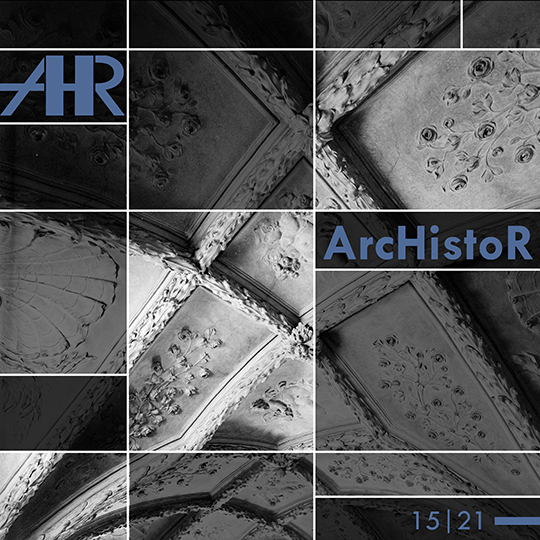
This article analyzes the relationship between stucco decoration and architecture through the investigation of the languages used by Baldassarre Fontana, cousin of the more famous Carlo. The study of the stucco decoration and some architectures created by Baldassarre in Moravia and Poland will allow to underline the innovative elements in the languages used by the architect and plasterer of Chiasso, compared with roman examples including the altar of Santa Maria in Traspontina designed by Carlo Fontana or the chapel of Santa Cecilia in San Carlo ai Catinari and some works by Bernini.
In Fontana’s work, the intention is to overturn the relationships between architecture and sculpture, in order to find the greatest possible separation between sculpture and architecture. Instead, in other yards, experimentation is already directed towards the rococò.
The paper will consider some cases including the decoration of the church of Saint Anne in Krakow dated 1695-1704 and the low undercut plastic decoration made on the gothic vaults of the Zydowski palace, also in Krakow. The examples of the Wawrzyniec Wodzicki palace or the funerary monuments built in Poland and Moravia are also interesting. The article also presents an analysis of the stucco technique used by Baldassarre Fontana and a comparison with the construction site practices used in the Roman area.
Downloads
Additional Files
- abstract ITA-ENG (Italiano)
- didascalie (Italiano)
- Testo paper (Italiano)
- dichiarazione autore (Italiano)
- fig. 1 (Italiano)
- Senza titolo (Italiano)
- Senza titolo (Italiano)
- Senza titolo (Italiano)
- Senza titolo (Italiano)
- Senza titolo (Italiano)
- Senza titolo (Italiano)
- Senza titolo (Italiano)
- Senza titolo (Italiano)
- Senza titolo (Italiano)
- Senza titolo (Italiano)
- Senza titolo (Italiano)
- Senza titolo (Italiano)
- Senza titolo (Italiano)
- Senza titolo (Italiano)
- Senza titolo (Italiano)
- Senza titolo (Italiano)
- Senza titolo (Italiano)
- Senza titolo (Italiano)
- fig. 20 (Italiano)
Published
How to Cite
Issue
Section
License
Copyright (c) 2021 Federico Bulfone Gransinigh

This work is licensed under a Creative Commons Attribution-NonCommercial 4.0 International License.
This journal provides immediate open access to its content on the principle that making research freely available to the public supports a greater global exchange of knowledge.
ArchIstoR is published on the web in open access.
Authors who publish with this journal agree to the following terms:
- authors retain copyright and grant the journal right of first publication with the work simultaneously licensed under a Creative Commons Attribution-NonCommercial 2.0 Generic License that allows others to share the work with an acknowledgement of the work's authorship and initial publication in this journal.
- Authors are able to enter into separate, additional contractual arrangements for the non-exclusive distribution of the journal's published version of the work (e.g., post it to an institutional repository or publish it in a book), with an acknowledgement of its initial publication in this journal.
- Authors are permitted and encouraged to post their work online (e.g., in institutional repositories or on their website) prior to and during the submission process, as it can lead to productive exchanges, as well as earlier and greater citation of published work (See The Effect of Open Access).






















 Comitato scientifico internazionale
