Designing Extractive Landscapes
Keywords:
riuso, extractive landscapes, design, strategies, enhancement, reuseAbstract
The paper addresses the topic of extractive landscapes as a possible field of investigation, as vast as considerably interesting, for the architectural design at its various scales. Through the reading of four contemporary designs – David Chipperfield Architects, Arcari quarry; Pierpaolo Perra and Alberto A. Loche, Park of sounds in the Sinis quarries; Donati D'Elia Associati, Recovery and enhancement of the quarries of Fantiano; DnA_Design and Architecture, Jinyun quarries – a reflection is developed on the role that the project can play in recovering abandoned quarry areas as architectural spaces to be allocated to new contemporary uses, or in transforming the disorientation that originates from abandonment into a resource for the territories.
Although far from any claim to exhaustiveness, this reading allows us to outline some ways of design intervention in extractive landscapes and to frame some issues that take on paradigmatic value for future operations in other conditions, in other contexts, with other forms of reuse.
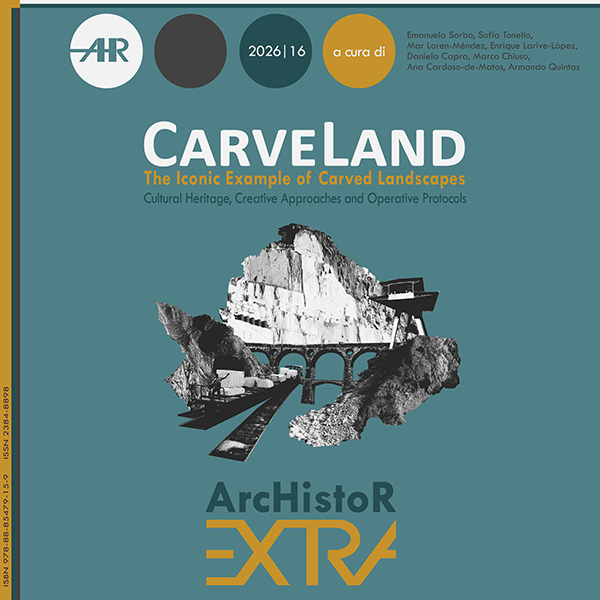
Downloads
Published
How to Cite
Issue
Section
License
Copyright (c) 2026 Mauro Marzo, Viola Bertini

This work is licensed under a Creative Commons Attribution-NonCommercial 4.0 International License.
This journal provides immediate open access to its content on the principle that making research freely available to the public supports a greater global exchange of knowledge.
ArchIstoR is published on the web in open access.
Authors who publish with this journal agree to the following terms:
- authors retain copyright and grant the journal right of first publication with the work simultaneously licensed under a Creative Commons Attribution-NonCommercial 2.0 Generic License that allows others to share the work with an acknowledgement of the work's authorship and initial publication in this journal.
- Authors are able to enter into separate, additional contractual arrangements for the non-exclusive distribution of the journal's published version of the work (e.g., post it to an institutional repository or publish it in a book), with an acknowledgement of its initial publication in this journal.
- Authors are permitted and encouraged to post their work online (e.g., in institutional repositories or on their website) prior to and during the submission process, as it can lead to productive exchanges, as well as earlier and greater citation of published work (See The Effect of Open Access).






















 Comitato scientifico internazionale
