The Manifesto of Modern Religious Architecture. The Mountain Chapel by Alberto Sartoris in Lourtier
DOI:
https://doi.org/10.14633/AHR353Keywords:
Alberto Sartoris, Chapel of Lourtier, functional architecture, sacred architectureAbstract
The realization of a sacred space represented a unicum in Alberto Sartoris’ career and, at the same time, it remained closely interrelated to his reflections on the architectural system throughout his long academic and professional activity. In this sense, the events linked to the realization of the Chapelle de Notre-Dame du Bon-Conseil, built in Lourtier, Switzerland, in 1932, were a precious testimony of the coherent application by Sartoris of the constructive and moral principles linked to functional architecture, of which he himself was a tenacious supporter since the early 1930s. After completion, this building was at the center of a fierce controversy, as it was considered scandalous and the architect accused of Bolshevism by the critics of the time. Renouncing most of the theories fiercely supported by Sartoris, this chapel was subject to a radical transformation during the 1950s and 1960s, in search of what has been repeatedly, erroneously defined as mere “architectural embellishment”. The aim of this study is to highlight the activity of Sartoris- architect through the study of the events related to the realization of that Manifesto of modern religious architecture, born in a mountain context, that of Lourtier, not far from the place where Sartoris grew up and lived until his death.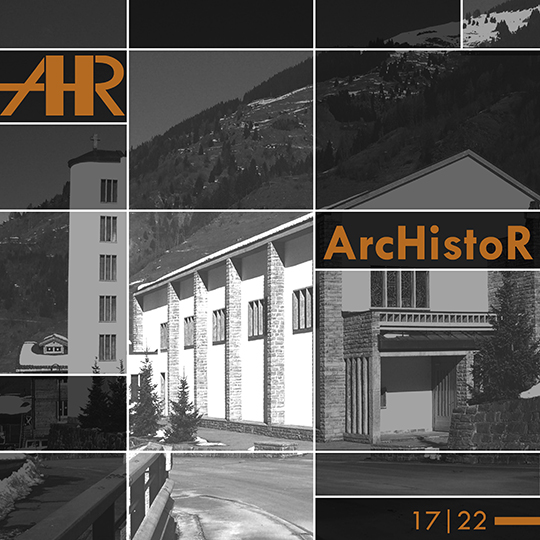
Downloads
Additional Files
Published
2022-07-27
How to Cite
Gavello, C. (2022). The Manifesto of Modern Religious Architecture. The Mountain Chapel by Alberto Sartoris in Lourtier. ArcHistoR Architecture History Restoration - Architettura Storia Restauro, (17), 162–177. https://doi.org/10.14633/AHR353
Issue
Section
vuoto1
License
Copyright (c) 2022 Cinzia Gavello

This work is licensed under a Creative Commons Attribution-NonCommercial 4.0 International License.
This journal provides immediate open access to its content on the principle that making research freely available to the public supports a greater global exchange of knowledge.
ArchIstoR is published on the web in open access.
Authors who publish with this journal agree to the following terms:
- authors retain copyright and grant the journal right of first publication with the work simultaneously licensed under a Creative Commons Attribution-NonCommercial 2.0 Generic License that allows others to share the work with an acknowledgement of the work's authorship and initial publication in this journal.
- Authors are able to enter into separate, additional contractual arrangements for the non-exclusive distribution of the journal's published version of the work (e.g., post it to an institutional repository or publish it in a book), with an acknowledgement of its initial publication in this journal.
- Authors are permitted and encouraged to post their work online (e.g., in institutional repositories or on their website) prior to and during the submission process, as it can lead to productive exchanges, as well as earlier and greater citation of published work (See The Effect of Open Access).






















 Comitato scientifico internazionale
