Regenerative Design as a Contribution to Understand Resilience to Climate Change
DOI:
https://doi.org/10.14633/AHR199Keywords:
Regenerative design, resilience, climate changes, green strategyAbstract
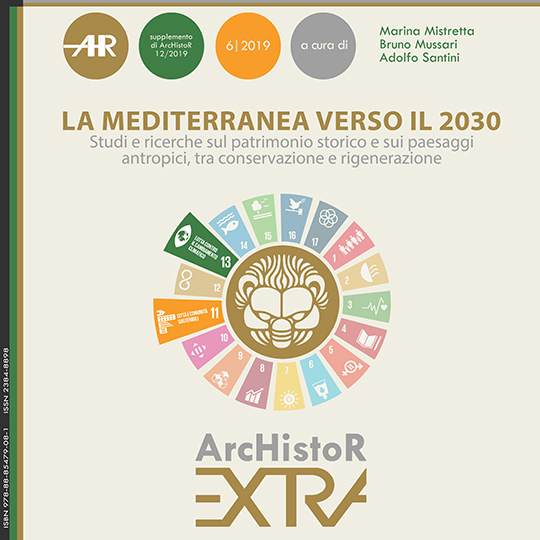
With this contribution to the open debate with the call "Mediterranea 2030" on the themes of the 2030 Sustainable Development Agenda, it is intended to underline how the Regenerative Design has contributed to a more conscious approach to the project of the built environment based on resilience to climate change and how, through a real planning strategy, we also intend to reconstruct in this environment a cultural and scientific scenario. Some remarks were started a few years ago with the Art Department of the Mediterranea University of Reggio Calabria, through the "Messaggeri della Conoscenza" Program, which developed the "Regenerative Design - Green Strategy" Project, hosting Prof. Cole, the company designed by Perkins+Will, a group of teachers and young researchers from many Italian universities.
Il Regenerative Design come contributo alla comprensione della resilienza ai cambiamenti climatici
Con questo contributo al dibattito aperto con la call “Mediterranea 2030” sui temi dell’Agenda sullo Sviluppo Sostenibile 2030, si intende sottolineare come il Regenerative Design abbia contribuito ad un più consapevole approccio al progetto dell’ambiente costruito in funzione della resilienza ai cambiamenti climatici e come attraverso una vera e propria strategia progettuale, s’intende ricostruire in questo contesto uno scenario culturale e scientifico. Alcune riflessioni su questi temi sono state avviate alcuni anni fa dal Dipartimento dArTe dell’Università Mediterranea di Reggio Calabria, attraverso il Programma “Messaggeri della Conoscenza”, che ha sviluppato il Progetto “Regenerative Design – Green Strategy”, ospitando il prof. Cole, la società di progettazione Perkins+Will e un folto gruppo di docenti e giovani ricercatori provenienti da molti atenei italiani.
Downloads
Published
How to Cite
Issue
Section
License
Copyright (c) 2019 Corrado Trombetta; Giovanni Cavanna

This work is licensed under a Creative Commons Attribution-NonCommercial 4.0 International License.
This journal provides immediate open access to its content on the principle that making research freely available to the public supports a greater global exchange of knowledge.
ArchIstoR is published on the web in open access.
Authors who publish with this journal agree to the following terms:
- authors retain copyright and grant the journal right of first publication with the work simultaneously licensed under a Creative Commons Attribution-NonCommercial 2.0 Generic License that allows others to share the work with an acknowledgement of the work's authorship and initial publication in this journal.
- Authors are able to enter into separate, additional contractual arrangements for the non-exclusive distribution of the journal's published version of the work (e.g., post it to an institutional repository or publish it in a book), with an acknowledgement of its initial publication in this journal.
- Authors are permitted and encouraged to post their work online (e.g., in institutional repositories or on their website) prior to and during the submission process, as it can lead to productive exchanges, as well as earlier and greater citation of published work (See The Effect of Open Access).






















 Comitato scientifico internazionale
