«Sicily is a land for Architects». The Arts & Crafts culture of Charles Robert Ashbee in Sicily (1907-1909)
DOI:
https://doi.org/10.14633/AHR131Keywords:
Journey, Sicily, Taormina, Arts & Crafts, monumentsAbstract
In 1907, the English architect Charles Robert Ashbee (1863-1942) was in Taormina, invited by his friend, Colonel Thomas Bradney Shaw-Hellier (1836-1910), to design the house he wanted to build in the Sicilian town. Trained at King's College, he is known to have been one of the principal protagonists of the Arts and Crafts movement. When Ashbee arrived in Sicily, we was immediately enthusiastic about Taormina, the ancient monuments and, of course, he was enchanted by Mount Etna. This trip also gave him the opportunity to visit some of the most important archaeological sites and other island towns. Through his Memoirs, preserved at the Victoria & Albert Library in London, which tell in diary form part of his life and activities between 1884 and 1923, it is possible to trace the places, the monuments, and the landscapes that excited him, without neglecting the many suggestions of the cultural and traditional aspects of Sicily. With an acute spirit and unfailing English humour, he described the landscape as well as the anthropological aspects of the Island, the habits and the character of the inhabitants.Between January and February 1907, Ashbee visited Syracuse, Agrigento. At the end of this brief but intense journey among the most important monuments of the island, he wrote: "Sicily is a land for Architects". During his Sicilian journey, he lived through the dramatic earthquake in the Strait of Messina of 1908, noting the horror of the destruction and desperation of the inhabitants. He was to return to his homeland in the following April, after the conclusion of the works on the villa he had designed for his English friend, which, transformed over the past few decades into a hotel, is now called Ashbee Hotel.
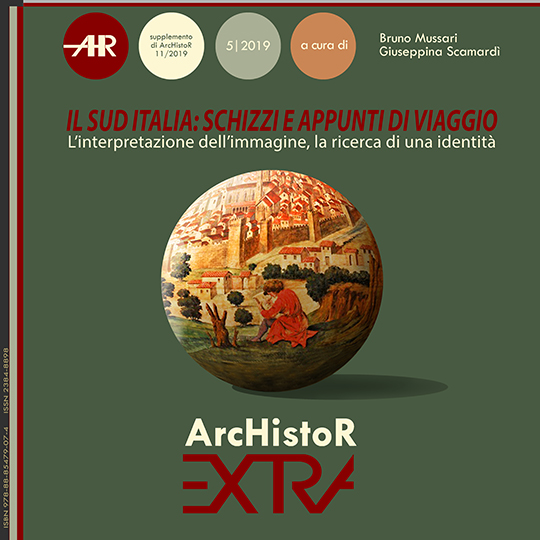
Downloads
Additional Files
- Didascalie (Italiano)
- Figura 1 (Italiano)
- FIgura 2 (Italiano)
- Figura 3 (Italiano)
- Figura 4 (Italiano)
- Figura 5 (Italiano)
- Figura 6 (Italiano)
- Figura 7 (Italiano)
- Figura 8 (Italiano)
- Figura 9 (Italiano)
- Figura 10 (Italiano)
- Figura 11 (Italiano)
- Figura 12 (Italiano)
- Figura 13 (Italiano)
- Figura 14 (Italiano)
- Figura 15 (Italiano)
- Figura 16 (Italiano)
- Figura 17 (Italiano)
- Figura 18 (Italiano)
- Figura 19 (Italiano)
- Figura 20 (Italiano)
- Figura 21 (Italiano)
- Figura 22 (Italiano)
- Figura 23 (Italiano)
- Figura 24 (Italiano)
- Figura 25 (Italiano)
- Figura 26 (Italiano)
Published
How to Cite
Issue
Section
License
Copyright (c) 2019 Francesca Passalacqua

This work is licensed under a Creative Commons Attribution-NonCommercial 4.0 International License.
This journal provides immediate open access to its content on the principle that making research freely available to the public supports a greater global exchange of knowledge.
ArchIstoR is published on the web in open access.
Authors who publish with this journal agree to the following terms:
- authors retain copyright and grant the journal right of first publication with the work simultaneously licensed under a Creative Commons Attribution-NonCommercial 2.0 Generic License that allows others to share the work with an acknowledgement of the work's authorship and initial publication in this journal.
- Authors are able to enter into separate, additional contractual arrangements for the non-exclusive distribution of the journal's published version of the work (e.g., post it to an institutional repository or publish it in a book), with an acknowledgement of its initial publication in this journal.
- Authors are permitted and encouraged to post their work online (e.g., in institutional repositories or on their website) prior to and during the submission process, as it can lead to productive exchanges, as well as earlier and greater citation of published work (See The Effect of Open Access).






















 Comitato scientifico internazionale
