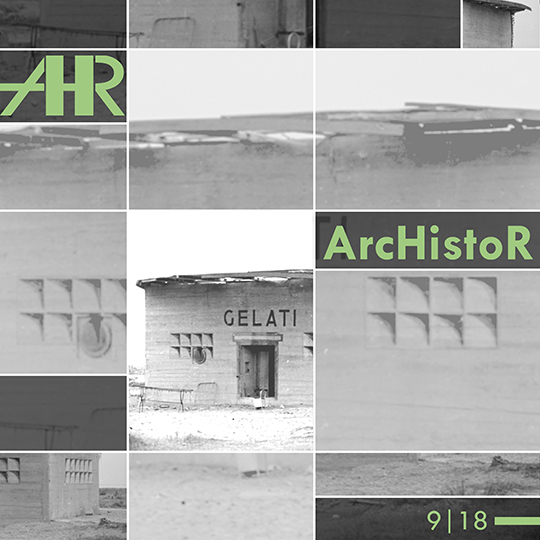
The German Bunker Built to Defend the Linea Galla Placidia. Preserving a Forgotten Heritage
DOI:
https://doi.org/10.14633/AHR067Keywords:
bunker, World War II, Gothic Line, reinforced concrete, conservationAbstract
After the armistice, the threat of an Allied landing on the Italian coasts of Romagna, north of the Gothic Line, spread among the German Army. This danger led to a real arms race, as it would have offered free access to the heart of the Third Reich. What ensued was therefore the organization of a strong line of defence consisting of bunkers, defensive emplacements and structures like dragon’s teeth. The landing, however, never took place and it turned out to be part of a deception strategy.
At the end of the war the bunkers were largely destroyed, silted or covered by sand; since then, only some of them have been reused as storages or warehouses. As rejected ruins they were never perceived as cultural heritage, but nowadays they offer the opportunity to reflect on their destiny.
Downloads
Additional Files
- Senza titolo (Italiano)
- Senza titolo (Italiano)
- Senza titolo (Italiano)
- Senza titolo (Italiano)
- Senza titolo (Italiano)
- Senza titolo (Italiano)
- Senza titolo (Italiano)
- Senza titolo (Italiano)
- Senza titolo (Italiano)
- Senza titolo (Italiano)
- Senza titolo (Italiano)
- Senza titolo (Italiano)
- Senza titolo (Italiano)
- Senza titolo (Italiano)
- Senza titolo (Italiano)
- Senza titolo (Italiano)
- Senza titolo (Italiano)
- Senza titolo (Italiano)
- Senza titolo (Italiano)
- Senza titolo (Italiano)
- Senza titolo (Italiano)
- Senza titolo (Italiano)
- Senza titolo (Italiano)
- Senza titolo (Italiano)
- Senza titolo (Italiano)
- Senza titolo (Italiano)
- Senza titolo (Italiano)
- Senza titolo (Italiano)
- Senza titolo (Italiano)
- Senza titolo (Italiano)
- Senza titolo (Italiano)
Published
How to Cite
Issue
Section
License
Copyright (c) 2018 Chiara Mariotti, Andrea Ugolini, Alessia Zampini

This work is licensed under a Creative Commons Attribution-NonCommercial 4.0 International License.
This journal provides immediate open access to its content on the principle that making research freely available to the public supports a greater global exchange of knowledge.
ArchIstoR is published on the web in open access.
Authors who publish with this journal agree to the following terms:
- authors retain copyright and grant the journal right of first publication with the work simultaneously licensed under a Creative Commons Attribution-NonCommercial 2.0 Generic License that allows others to share the work with an acknowledgement of the work's authorship and initial publication in this journal.
- Authors are able to enter into separate, additional contractual arrangements for the non-exclusive distribution of the journal's published version of the work (e.g., post it to an institutional repository or publish it in a book), with an acknowledgement of its initial publication in this journal.
- Authors are permitted and encouraged to post their work online (e.g., in institutional repositories or on their website) prior to and during the submission process, as it can lead to productive exchanges, as well as earlier and greater citation of published work (See The Effect of Open Access).






















 Comitato scientifico internazionale
