Vittone 1920-2020. Afterword
DOI:
https://doi.org/10.14633/AHR328Keywords:
historiography, architect’s libraries, biography, educationAbstract
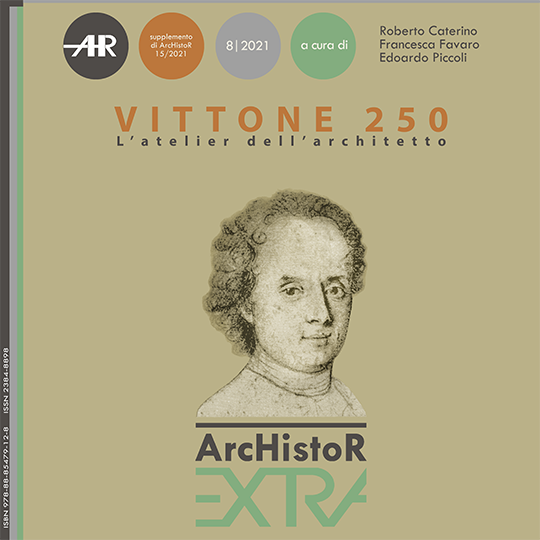
Since the resumption of the studies on Bernardo Vittone in the mid-nineties, a significant amount of research has been directed to filling the existing gaps in the knowledge on the architect’s biography. While many uncertainties still exist, Vittone’s life appears now better outlined, especially thanks to recent investigations on his youth in Turin and on his clients. A key issue that has emerged is represented by the particular character of Vittone’s culture, marked by his social origins as much as by his discovery, throughout the years of his architectural training, of the complexity of the Roman baroque tradition. In fact, what he studied and learned in Rome appears to have convinced him of the accuracy of his ideas, already marked, in his earlier education, by an in depth knowledge of Guarini’s architecture. From his return to Turin in 1733 to the end of his career in 1770, Vittone has constantly reconsidered the coordinates of his professional education: never rejecting them but measuring them with the new directions of thought that developed since the middle of the century, sometimes opening a conflict between the glorious, recent architectural past and the emerging “rationalist” and classicist requirements. The present survey, dedicated to the 250th anniversary of Vittone’s death, is an opportunity to highlight new, necessary research paths on the architect’s life, his drawings, his publications, his library.
Downloads
Published
How to Cite
Issue
Section
License
This journal provides immediate open access to its content on the principle that making research freely available to the public supports a greater global exchange of knowledge.
ArchIstoR is published on the web in open access.
Authors who publish with this journal agree to the following terms:
- authors retain copyright and grant the journal right of first publication with the work simultaneously licensed under a Creative Commons Attribution-NonCommercial 2.0 Generic License that allows others to share the work with an acknowledgement of the work's authorship and initial publication in this journal.
- Authors are able to enter into separate, additional contractual arrangements for the non-exclusive distribution of the journal's published version of the work (e.g., post it to an institutional repository or publish it in a book), with an acknowledgement of its initial publication in this journal.
- Authors are permitted and encouraged to post their work online (e.g., in institutional repositories or on their website) prior to and during the submission process, as it can lead to productive exchanges, as well as earlier and greater citation of published work (See The Effect of Open Access).






















 Comitato scientifico internazionale
