The Metal Dome of the Paris "Halle au Blé", a Mechanical Architecture
DOI:
https://doi.org/10.14633/AHR135Keywords:
Dome, collaborations, experimentations, metals, challengesAbstract
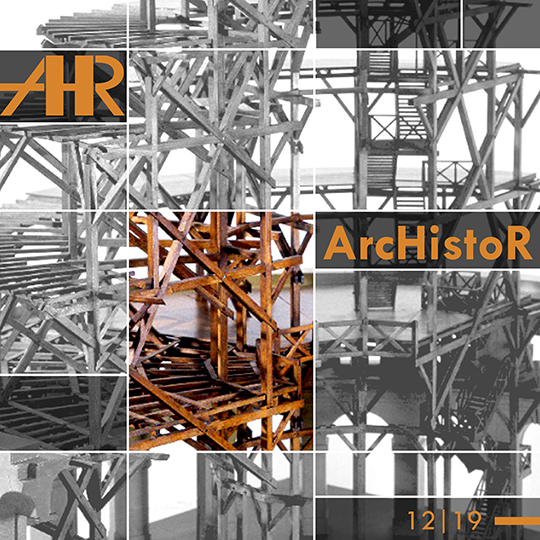
The construction of the metal framework of the former Paris's corn exchange building was a strategical issue for the city’s flour supply. This monument, also called the “Louvre of the people” by Napoleon himself, had to be lastingly protected. Erected at the dawn of the French industrial Revolution, this cupola foreshadows a century of iron architecture in Europe. Its yard (1808-1813) ushers pioneering collaborations and new professional practices in the art of building. The architect François-Joseph Bélanger and the controller François Brunet follow an original process, where the calculation become a tool to measure accurately the prefabricated parts of the structure. Together, they offer an innovating solution to cover the monument built by Nicolas Le Camus de Mézières in 1783 and to replace the wooden dome realized by Jacques-Guillaume Legrand and Jacques Molinos in 1783, destroyed by fire in 1802. Mention the different stages of the elaboration of this metallic dome, «accomplished with the accuracy of a clockwork», allow to define the complex realization of this architectural achievement.
Downloads
Published
How to Cite
Issue
Section
License
Copyright (c) 2019 Jean-Roch Dumont Saint-Priest

This work is licensed under a Creative Commons Attribution-NonCommercial 4.0 International License.
This journal provides immediate open access to its content on the principle that making research freely available to the public supports a greater global exchange of knowledge.
ArchIstoR is published on the web in open access.
Authors who publish with this journal agree to the following terms:
- authors retain copyright and grant the journal right of first publication with the work simultaneously licensed under a Creative Commons Attribution-NonCommercial 2.0 Generic License that allows others to share the work with an acknowledgement of the work's authorship and initial publication in this journal.
- Authors are able to enter into separate, additional contractual arrangements for the non-exclusive distribution of the journal's published version of the work (e.g., post it to an institutional repository or publish it in a book), with an acknowledgement of its initial publication in this journal.
- Authors are permitted and encouraged to post their work online (e.g., in institutional repositories or on their website) prior to and during the submission process, as it can lead to productive exchanges, as well as earlier and greater citation of published work (See The Effect of Open Access).






















 Comitato scientifico internazionale
