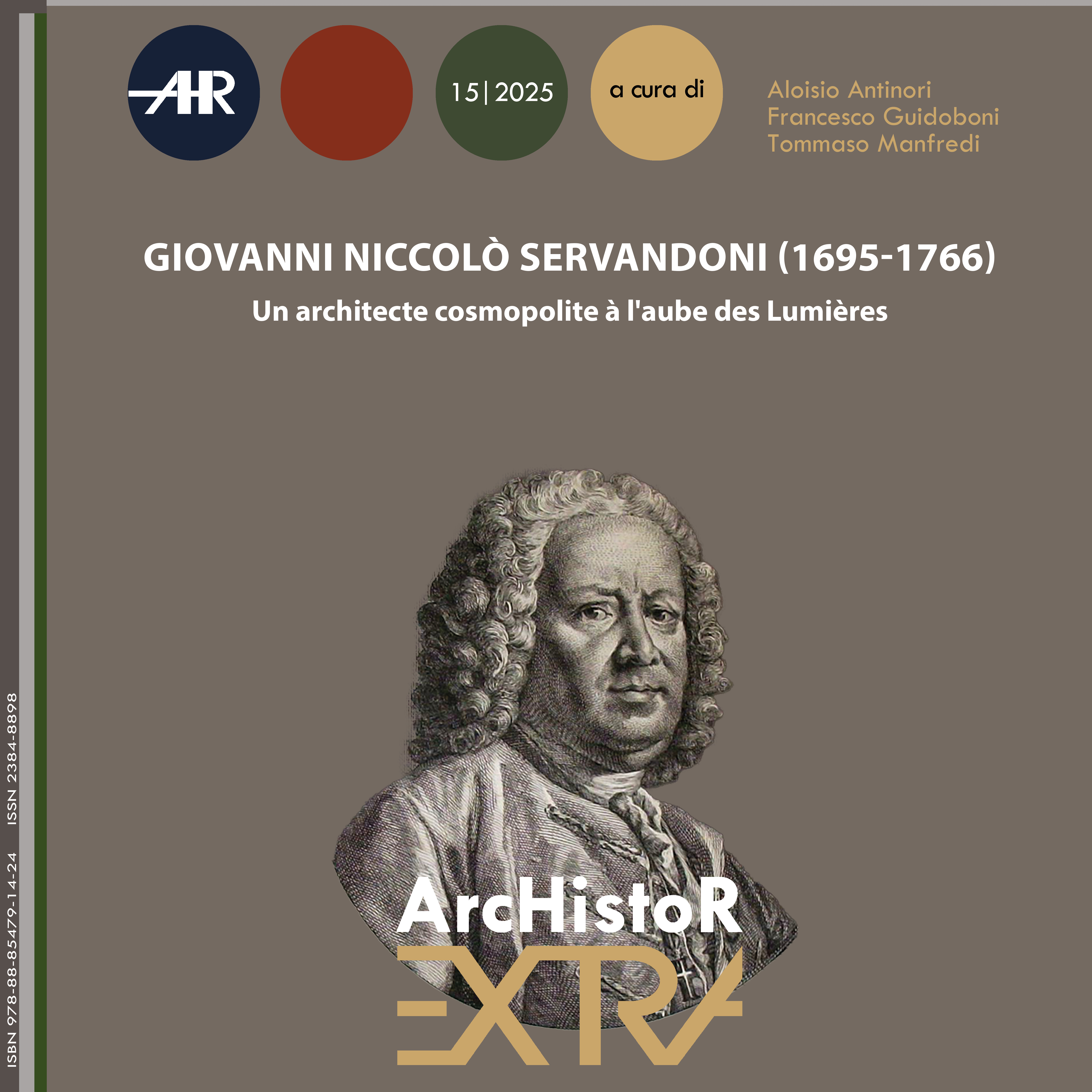
Giovanni Niccolò Servandoni à Lisbonne
DOI:
https://doi.org/10.14633/AHR463Keywords:
Giovanni Niccolò Servandoni , Lisbona, complexe architectural das Necessidades, théâtre éphémèreAbstract
Le temps que Giovanni Niccolò Servandoni passa à Lisbonne, entre 1745 et 1747, est la période la moins connue de sa biographie artistique. Cet essai contextualise le séjour de l’architecte au Portugal dans le cadre des politiques artistiques et architecturales promues par le roi Jean V, en réfléchissant de manière critique sur les données artistiques et documentaires connues jusqu’à présent, ainsi que sur les raisons des attributions contradictoires avancées au fil du temps par les chercheurs. En particulier, il analyse les différentes positions critiques qui ont attribué ou nié l’implication de Servandoni dans le projet et la construction du complexe architectural das Necessidades, mettant en évidence des éléments caractéristiques de son langage architectural, à la fois dans la source scénographique et dans le portique de l’église. Les circonstances ayant favorisé le séjour portugais de l’architecte sont à rechercher dans le lien étroit entre les cours de Madrid et de Lisbonne, grâce au cercle des princes des Asturies et, en particulier, à Maria Barbara de Bragance, fille de Jean V. L’épisode regrettable concernant la croix de l’Ordre du Christ provoqua la détérioration soudaine de cette opportunité et poussa Servandoni à quitter la péninsule ibérique pour s’installer en Angleterre. Les raisons de son départ de Lisbonne peuvent ainsi être trouvées dans les tensions avec les architectes et ingénieurs militaires portugais, la perte de la faveur de la cour, et l’apparition de meilleures perspectives offertes par les commanditaires anglais, grâce à la construction du théâtre éphémère que Servandoni réalisa en 1746 à Lisbonne pour leur communauté.
Giovanni Niccolò Servandoni in Lisbon
The time Giovanni Niccolò Servandoni spent in Lisbon, between 1745 and 1747, is the least known period of his artistic biography. This essay contextualizes the architect's stay in Portugal within the artistic and architectural policies promoted by King John V, critically reflecting on the artistic and documentary evidence known so far, as well as on the reasons behind the contrasting attributions made over time by scholars. In particular, it analyzes the different critical positions that have attributed or denied Servandoni's involvement in the project and construction of the Necessidades architectural complex, highlighting elements characteristic of his architectural language in both the scenographic source and the church portico. The circumstances that facilitated the architect's Portuguese stay can be traced to the close connection between the courts of Madrid and Lisbon, thanks to the circle of the Princes of Asturias and, in particular, Maria Barbara of Braganza, daughter of John V. The unfortunate episode concerning the cross of the Order of Christ caused a sudden deterioration of this opportunity and led Servandoni to leave the Iberian Peninsula and move to England. The reasons for his departure from Lisbon can thus be found in the hostility of Portuguese military architects and engineers, the waning favor of the court, and the emergence of better prospects offered by English patrons, thanks to the construction of the ephemeral theater that Servandoni created in 1746 in Lisbon for their community.
Published
How to Cite
Issue
Section
License
Copyright (c) 2026 Giuseppina Raggi

This work is licensed under a Creative Commons Attribution-NonCommercial 4.0 International License.
This journal provides immediate open access to its content on the principle that making research freely available to the public supports a greater global exchange of knowledge.
ArchIstoR is published on the web in open access.
Authors who publish with this journal agree to the following terms:
- authors retain copyright and grant the journal right of first publication with the work simultaneously licensed under a Creative Commons Attribution-NonCommercial 2.0 Generic License that allows others to share the work with an acknowledgement of the work's authorship and initial publication in this journal.
- Authors are able to enter into separate, additional contractual arrangements for the non-exclusive distribution of the journal's published version of the work (e.g., post it to an institutional repository or publish it in a book), with an acknowledgement of its initial publication in this journal.
- Authors are permitted and encouraged to post their work online (e.g., in institutional repositories or on their website) prior to and during the submission process, as it can lead to productive exchanges, as well as earlier and greater citation of published work (See The Effect of Open Access).






















 Comitato scientifico internazionale
