Da Versailles a Parigi, città capitale (1748-1764). Il moderno gusto ‟à la grecqueˮ moralizzato dall’Illuminismo
DOI:
https://doi.org/10.14633/AHR460Keywords:
Giovanni Niccolò Servandoni , goût à la grecque , XVIII secolo, IlluminismoAbstract
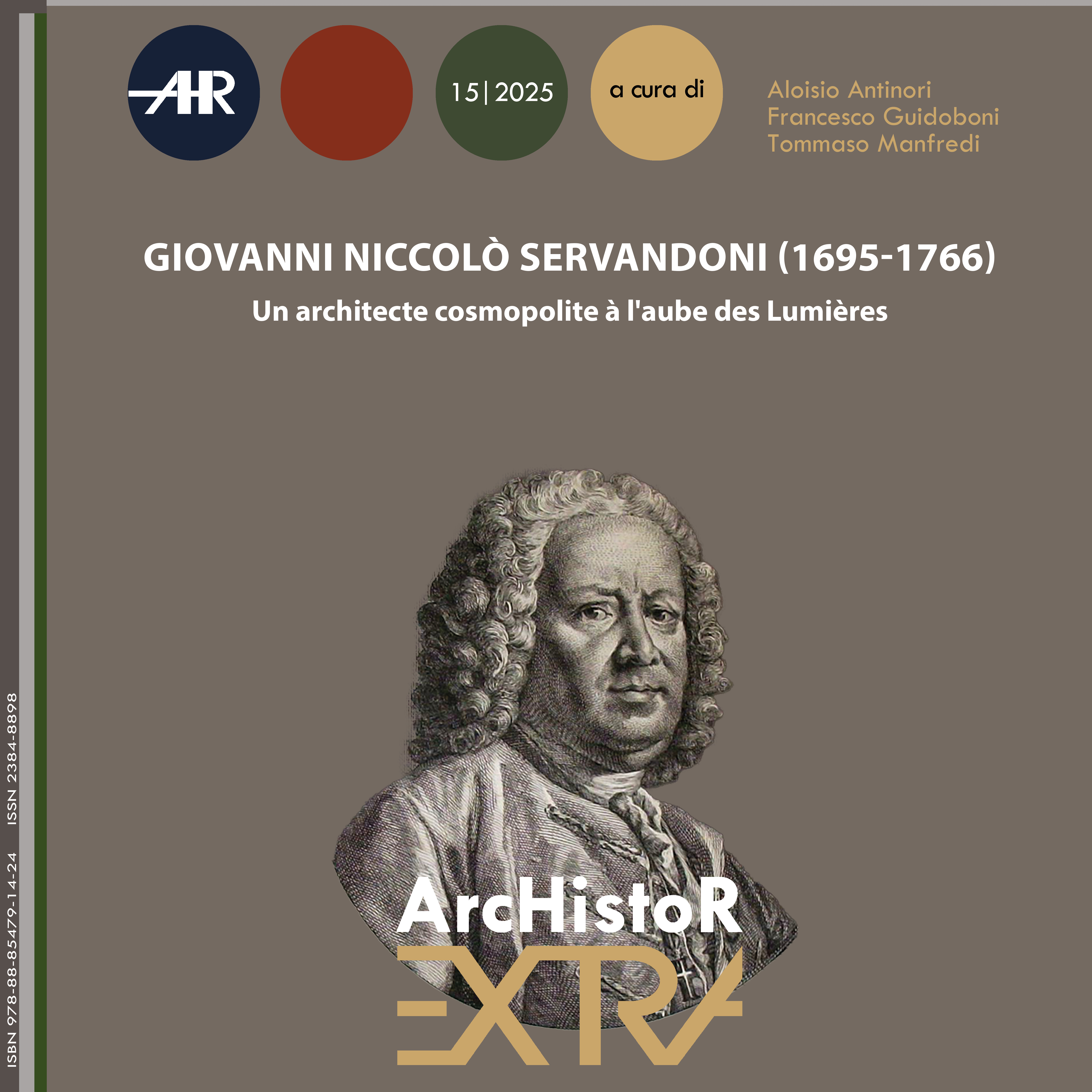
Il testo esplora l’evoluzione dell’architettura e delle arti durante il regno di Luigi XV, caratterizzato dal passaggio dallo stile rocaille al «goût à la grecque», ispirato all’Antichità reinterpretata. Questo periodo, compreso tra il 1748 (trattato di Aquisgrana) e il 1764 (posa della prima pietra di Sainte-Geneviève), è segnato dalle tensioni tra tradizione e innovazione, incarnate da due figure chiave: Ange-Jacques Gabriel, che preserva i codici del classicismo francese, e Jacques-Germain Soufflot, che introduce elementi innovativi ispirati all’architettura greca, come si vede in Sainte-Geneviève (futuro Panthéon), simbolo di rigenerazione culturale e politica. Servandoni, con la facciata di Saint-Sulpice e i suoi decori effimeri, e Bouchardon, autore della Fontana delle Quattro Stagioni, sono precursori di questa transizione, unendo l’eleganza dell’Antichità alle innovazioni del modernismo nascente. Il ruolo di Marigny e Madame de Pompadour è determinante nel promuovere questi nuovi orientamenti artistici, sostenendo questi creatori visionari. La trilogia monumentale del regno – l’École militaire, Sainte-Geneviève e la place Louis XV – incarna una politica delle arti volta a rappresentare i Tre Ordini (Nobiltà, Clero, Terzo Stato) e la grandezza reale. Le critiche di Blondel e Laugier rivelano i dibattiti teorici sull’estetica e sull’uso degli ordini architettonici, segnando una svolta fondamentale nella storia dell’architettura in Francia.
From Versailles to Paris, the Capital City (1748-1764). Modern Taste ‟à la grecqueˮ Moralized by the Enlightenment
The text explores the evolution of architecture and the arts during the reign of Louis XV, characterized by the transition from the rocaille style to the "goût à la grecque," inspired by a reinterpreted Antiquity. This period, spanning from 1748 (the Treaty of Aix-la-Chapelle) to 1764 (the laying of the first stone of Sainte-Geneviève), is marked by tensions between tradition and innovation, embodied by two key figures: Ange-Jacques Gabriel, who preserves the codes of French classicism, and Jacques-Germain Soufflot, who introduces innovative elements inspired by Greek architecture, as seen in Sainte-Geneviève (the future Panthéon), a symbol of cultural and political regeneration. Servandoni, with the façade of Saint-Sulpice and its ephemeral decorations, and Bouchardon, the creator of the Fountain of the Four Seasons, are pioneers of this transition, blending the elegance of Antiquity with the innovations of emerging modernism. The role of Marigny and Madame de Pompadour is crucial in promoting these new artistic directions, supporting these visionary creators. The monumental trilogy of the reign – the École militaire, Sainte-Geneviève, and the Place Louis XV – embodies a policy of the arts aimed at representing the Three Estates (Nobility, Clergy, Third Estate) and royal grandeur. The critiques of Blondel and Laugier reveal the theoretical debates on aesthetics and the use of architectural orders, marking a fundamental turning point in the history of architecture in France.
Published
How to Cite
Issue
Section
License
Copyright (c) 2026 Daniel Rabreau

This work is licensed under a Creative Commons Attribution-NonCommercial 4.0 International License.
This journal provides immediate open access to its content on the principle that making research freely available to the public supports a greater global exchange of knowledge.
ArchIstoR is published on the web in open access.
Authors who publish with this journal agree to the following terms:
- authors retain copyright and grant the journal right of first publication with the work simultaneously licensed under a Creative Commons Attribution-NonCommercial 2.0 Generic License that allows others to share the work with an acknowledgement of the work's authorship and initial publication in this journal.
- Authors are able to enter into separate, additional contractual arrangements for the non-exclusive distribution of the journal's published version of the work (e.g., post it to an institutional repository or publish it in a book), with an acknowledgement of its initial publication in this journal.
- Authors are permitted and encouraged to post their work online (e.g., in institutional repositories or on their website) prior to and during the submission process, as it can lead to productive exchanges, as well as earlier and greater citation of published work (See The Effect of Open Access).






















 Comitato scientifico internazionale
