Landscape Fragments: “The Iconic Example of Carrara Carved Landscape”. Studies and Research
DOI:
https://doi.org/10.14633/AHR447Keywords:
Quarrying heritage, Cultural landscape, Carveland, Quarries, MarbleAbstract
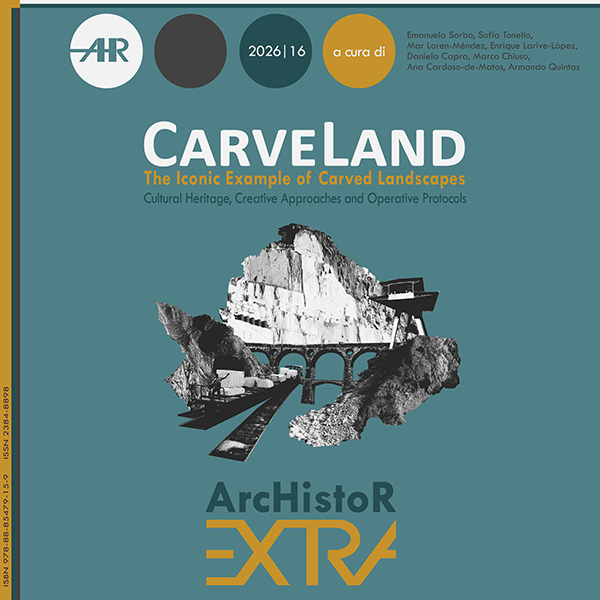
Marble quarries are fragments of the landscape where natural, urban, productive, and cultural dimensions coexist, encompassing both industrial archaeological sites and objects of artistic and material significance. In these contexts, traditional heritage protection tools often struggle to address the needs of local communities, due to the challenge of integrating the diverse tangible and intangible values inherent to quarrying heritage.
The CARVEland network’s research is based on a comparative study of three European marble basins – Carrara, Vila Viçosa, and Macael – selected as case studies representative of different production traditions and territorial structures. Grounded in a shared theoretical and regulatory framework, the project explores how quarrying activity drives transformations in the landscape, alongside associated social, economic, and cultural shifts.
This comparative analysis is complemented by a systematic study of the Carrara basin, including an examination of the current legislative framework, a critical review of relevant literature, and a semantic cataloguing of key concepts related to quarrying heritage. This approach allows for a layered and dynamic interpretation of quarry sites, where excavation, emptiness, context, and landscape are understood as components of an ongoing process of transformation and redefinition of cultural value.
Downloads
Published
How to Cite
Issue
Section
License
Copyright (c) 2026 Emanuela Sorbo, Sofia Tonello

This work is licensed under a Creative Commons Attribution-NonCommercial 4.0 International License.
This journal provides immediate open access to its content on the principle that making research freely available to the public supports a greater global exchange of knowledge.
ArchIstoR is published on the web in open access.
Authors who publish with this journal agree to the following terms:
- authors retain copyright and grant the journal right of first publication with the work simultaneously licensed under a Creative Commons Attribution-NonCommercial 2.0 Generic License that allows others to share the work with an acknowledgement of the work's authorship and initial publication in this journal.
- Authors are able to enter into separate, additional contractual arrangements for the non-exclusive distribution of the journal's published version of the work (e.g., post it to an institutional repository or publish it in a book), with an acknowledgement of its initial publication in this journal.
- Authors are permitted and encouraged to post their work online (e.g., in institutional repositories or on their website) prior to and during the submission process, as it can lead to productive exchanges, as well as earlier and greater citation of published work (See The Effect of Open Access).






















 Comitato scientifico internazionale
